
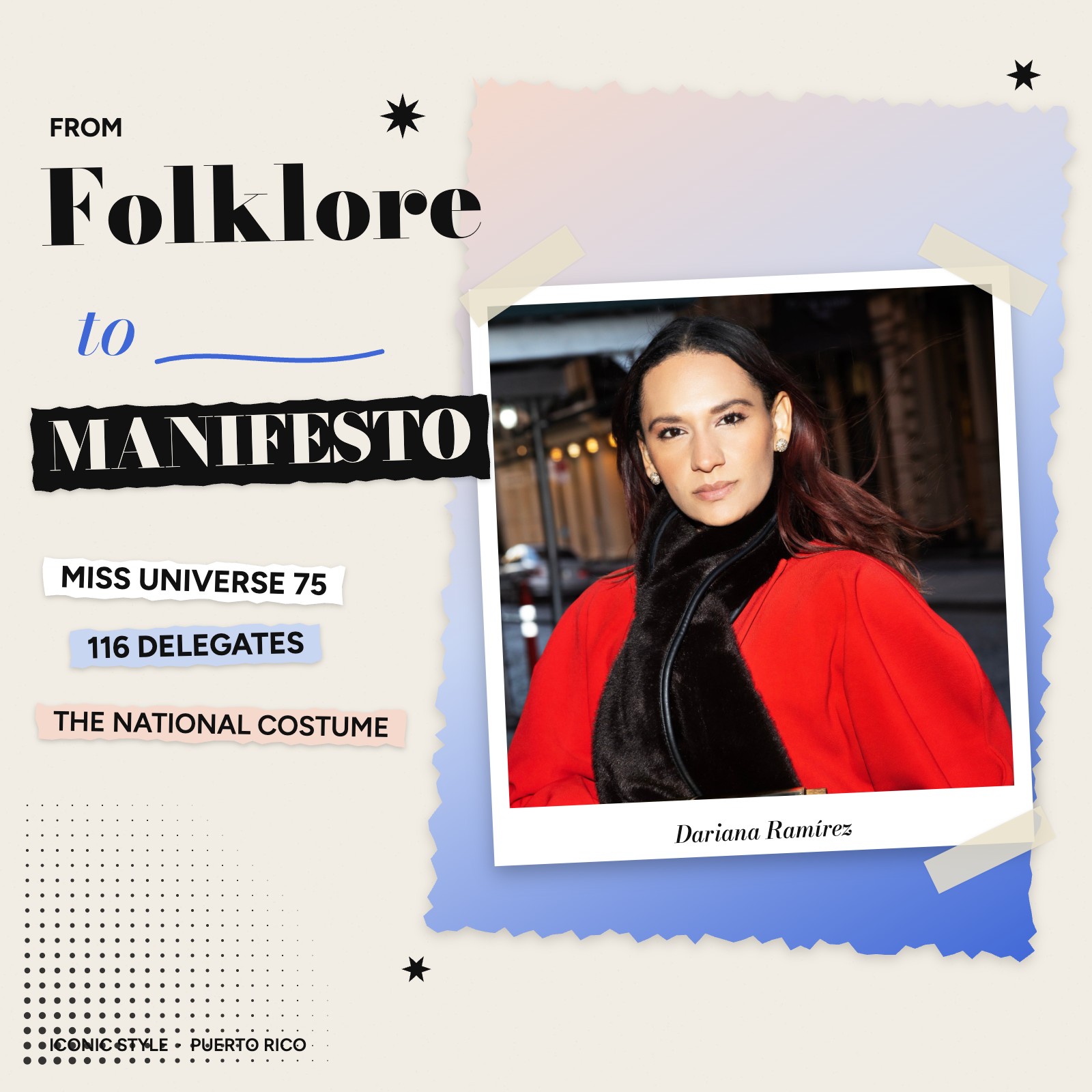
On Saturday, November 21, at the Coliseo de Puerto Rico José Miguel Agrelot, 116 delegates walked in the national costume competition of the 75th Miss Universe. There were feathers, crystals and structures that took up half the stage, as always. But what people in the stands talked about most was not the size of the costumes. It was what they said: leaves that opened on their own, 75 portraits of political prisoners on a white gown, a scepter with the world at its tip.
This piece traces that transformation in three movements: from folk dress to spectacle, from spectacle to technology, and from landscape to message. It closes with my five favorite costumes of the night and the story behind each one.
From Folkloric Postcard to Sculpture
For decades, the national costume was almost literal: the contestant wore her country’s traditional dress, or a shinier version of it. Miss USA, for example, walked for years as Uncle Sam, as a cowgirl or as the Statue of Liberty.
Over time, the costume became a genre of its own, closer to carnival and opera costuming than to folklore. The country is no longer worn: it is interpreted. A national bird becomes two-meter wings; a pre-Hispanic goddess becomes a monumental headdress. In 2023, Sheynnis Palacios wore the zanate, Nicaragua’s national bird, in a winged piece of feathers and crystals by designer Jorge Salazar. Weeks later, she was crowned Miss Universe.
The price of that ambition is measured in hours. Mexico’s “Xochiquetzal,” which Fátima Bosch wore in 2025 before winning the crown, took seven months to make. Behind every costume there are workshops, embroiderers, sculptural frames and, more and more often, engineers.
The Age of Movement
The big leap of recent years is that the costume is no longer just looked at: it performs. It opens, closes, lights up and tells its story in the 30 seconds it takes to cross the runway.
Puerto Rico was the best example of the night. “Moriviví: Renacer Borincano,” by Joshuan Aponte, has six large leaves that close and open again with a special mechanism, just like the plant does when you touch it. It is not the first time Aponte has built technology into a Puerto Rican costume: one of his earlier Miss Universe designs used LED lights to simulate wind and lightning.
Movement has also changed how costumes are designed. A costume is now planned like choreography: what happens on the entrance, when the big reveal comes and how it will look in a few seconds of vertical video. The phone camera is, in practice, one more judge.
From Landscape to Manifesto
Nature and folklore still dominate the runway, but they no longer hold a monopoly. Contestants now dare to wear their country’s faith, historical memory and politics, subjects that only a few years ago were considered a risk in a pageant.
- Faith. In 2024, Cuba wore a costume inspired by Oshún and the Virgin of Charity of El Cobre, uniting Afro-Cuban Santería and the island’s Catholic patron saint. In 2025, Brazil dressed as Our Lady of Aparecida.
- Political memory. This year, Cuba dedicated its costume to the Ladies in White and the 75 dissidents jailed during the Black Spring of 2003.
- A global message. Nicaragua walked with a costume about peace and a world without borders.
- Social history. The USA left Uncle Sam behind to honor the women who broke barriers in the country.
The shift makes sense. Miss Universe increasingly rewards contestants with a cause and a voice, and the national costume is the one moment they can say something without opening their mouths.
My Top 5 of the Night
I chose them for four things: the strength of the concept, the construction, how it worked live and the risk it took. This is not a prediction of the award. It is what moved me most from my seat.
1. Nicaragua – “El Vuelo De La Paz” (the Flight of Peace)
Worn by: Jasmine Blandford.
The costume. Blue, white and gold, with a towering fan of blue and white feathers behind a golden headdress and spread golden wings. The Nicaraguan flag wraps around the costume like a ribbon, alongside scenes of Nicaraguan streets. It is crowned by a golden scepter with a globe at its tip.
The story behind it. The design draws on three ideas: purity, national identity and hope. Its message is that peace and unity should have no borders. Who wears it makes it weigh more: Blandford was born in the United States to parents from Kukra Hill, on Nicaragua’s Caribbean coast, and was crowned in Florida. This is a diaspora queen talking about a world without borders.
Why it made my top 5. Nicaragua could have played it safe with a national bird, like the zanate that helped crown Sheynnis Palacios in 2023. Instead, it chose an idea. The wings are no longer wildlife: they are flight, journey, migration.
2. Cuba – “La Dama De La Libertad” (the Lady of Liberty)
Worn by: Mia Dio (Mia Angelina Donadio Cancio). Designed by: Panamanian designer Róyer Pérez.
The costume. White, with gold embroidery and white gladioli. It carries small portraits of the 75 dissidents jailed during the Black Spring of 2003, and crystal teardrops for the pain of their families. On the back is the Church of Santa Rita de Casia in Havana, where the Ladies in White gathered before their Sunday marches. Near the hem, it reads “todos marchamos” (we all march).
The story behind it. The Ladies in White began as the mothers, wives and daughters of those prisoners, who marched in silence, dressed in white with a gladiolus in hand, to demand their release. The costume includes a dedication to Laura Pollán, one of the group’s founders. Mia Dio had already dedicated a photo shoot to them when she was a candidate for her national title.
Why it made my top 5. It was the most openly political costume of the night and the perfect example of this article’s argument. There is no wildlife and no landscape: there is memory. And it gets there without losing elegance; the white and gold make the tribute read as solemn, not as a pamphlet. It received a standing ovation at the Coliseo.
3. Mexico – “Cosmos Wixárika”
Worn by: María Vargas. Designed by: Jalisco designer Joel Guadalupe García.
The costume. Entirely pink. A sheer, long-sleeved bodysuit covered in crystals, sequins and beads in fuchsia and pastel pink, with beaded fringe on the sleeves and torso. On stage, two sculpted flamingos rise from the shoulders, and the headpiece carries ostrich and pheasant plumes dyed in several shades of pink. The key piece is the back: a giant fan of hot-pink feathers that opens behind her like a flower.
The story behind it. The name comes from the worldview of the Wixárika (Huichol) people, whose art features deer, corn, peyote, eagles and geometric figures. It has been linked to the tzicurri, or “God’s eye,” a symbol of vision and protection. The costume won the national costume competition at Miss Universo México on August 26 in Los Cabos, and it has divided social media ever since.
Why it made my top 5. It is the costume that raises the most questions: can Wixárika art, known for its intense color, be told in a single shade of pink? That monochrome bet is exactly what makes it fashion and not costume. Mexico also arrived as the outgoing queen’s country: Fátima Bosch won in 2025 wearing a Xochiquetzal costume, so the comparison was inevitable.
4. Puerto Rico – “Moriviví: Renacer Borincano” (Moriviví: Boricua Rebirth)
Worn by: Jennifer Barreto. Designed by: Joshuan Aponte, his seventh national costume for a Puerto Rican delegate at Miss Universe.
The costume. Six large leaves that close and open again on stage with a special mechanism. Bright green fronds, with pink pompom blooms like the plant’s own flowers, and a soft pink burst crowning the headpiece. It took more than 100 hours to make and was first presented at Walter Otero Contemporary Art gallery.
The story behind it. The moriviví is the wild plant that folds its leaves when you touch it and opens them again later; almost every Puerto Rican played with it as a child. It is the official flower of Caguas. The costume uses it as a metaphor for a people who close up to protect themselves and then come back to life. Barreto has said she recognized herself in that story. Fun fact: she wanted a tostones costume, but she was not allowed to.
Why it made my top 5. It is the costume that best joins this article’s two trends: technology in service of the message. The movement is not a trick; it is the story itself. And at home, with the Coliseo roaring, the moment the leaves opened was one of the strongest of the night.
5. USA – a Tribute to the Women Who Broke Barriers
Worn by: Justus Kelley.
The costume. Red, white and blue, with a fan of shimmering fibers behind her. From the fibers rise black-and-white newspaper front pages, each with a year and a milestone for women in the United States: women winning the right to vote in 1920; an African American woman in a beauty pageant in 1959; Sally Ride, the first American woman in space, in 1983; Carole Gist, the first Black Miss USA, in 1990; a headline about refusing to give up a seat, a nod to Rosa Parks; and another about a married mother winning a title. The center front page is dated 2026 and is about her: a wife, a foster mom, over 30, and Miss USA.
The story behind it. Kelley is herself one of those broken barriers. At 31, she became the first married woman, the first mother and the oldest winner in Miss USA history. She competed for the national crown in secondhand clothes. And she flew to Puerto Rico in a coat printed with the image of Mary Leona Gage, the 1957 Miss USA who was stripped of her title when it came out that she was married with children.
Why it made my top 5. It was the clearest change of direction of the night. For decades, the USA walked with national symbols: Uncle Sam, cowgirls, the Statue of Liberty. This year it traded the monument for the women, and the costume became an extension of its wearer’s own story. There was a precedent: in 2016, Deshauna Barber wore a superhero costume about women’s empowerment.
The Uncomfortable Question: Art, Propaganda or Strategy?
A costume that speaks about politics or faith opens a legitimate debate, and there are good arguments on both sides.
- For: the costume is the only visual platform a contestant has to show her real country, not just the postcard version. A pageant that asks for a “cause” cannot also ask for neutral costumes.
- Against: an international pageant brings together countries in conflict with one another, and mixing beauty with political messages can divide the audience or turn the runway into a podium.
- The underlying doubt: how much is conviction and how much is strategy? A costume with a message generates headlines, conversation and social media votes.
The answer probably lies in the execution. When the message and the design are the same thing, as with Cuba or Puerto Rico this year, the costume reads as art. When the message is glued on top, it shows.
Closing
The national costume is living a moment much like haute couture: being beautiful is no longer enough; it has to mean something. On Saturday in San Juan, we saw plants that breathe, gowns that hold memory, front pages that rewrite history and wings that speak of migration. The crown will be decided on November 24, but the November 21 runway already made clear where the genre is heading.