
Claudia Romo Edelman spent three decades as a marketer and advocate working on how Latinos are seen in the United States. Her newest argument is a bottle. Speaking in Spanish with Iconic Original Media founder Advin Illa, she described Sotol Romo as the result of “800 years of history” in northern Mexico, and made the case that sotol is the category that follows tequila and mezcal. Watch the full conversation here.
What Sotol Is, and Why It Is Not Tequila or Mezcal
Sotol is named for the plant it comes from. Sotol Romo is made from 100% Dasylirion cedrosanum, a wild desert plant, according to the brand, which is botanically distinct from the agave behind tequila and mezcal. It is produced in Chihuahua, Mexico’s denomination of origin region for sotol.
Romo Edelman argues the category is far older than its shelf presence suggests. Sotol has been found across northern Mexico and the southern United States for some 800 years, she said, but Prohibition-era bans stopped commercial production on both sides of the border, and sotol was the last of Mexico’s spirits to have that restriction lifted and to receive its denomination of origin. “We are talking about a newborn,” she said of the commercial category.
A Plant That Takes 15 to 20 Years
The plant is the constraint and, in her telling, the story. Sotol takes 15 to 20 years to mature in the Chihuahuan desert, growing through extreme heat, cold and near-absent water, with male and female plants that must pollinate in those conditions. By comparison, she noted, agave takes roughly seven years.
“The plant does all the work,” she said. Her comparison is to wine: the more a plant struggles, the better the liquid. It is also why she rejects the idea of scaling quickly. “You cannot rush it,” she said. “There is no way to grow this plant and have it come out in two minutes.”
Three Ingredients and Nothing Else
Sotol Romo is made with three inputs: the plant, water, and the natural fermentation of the surrounding environment. The brand describes the spirit as additive-free, and Fred Minnick reported that it is certified organic and kosher.
That profile is aimed at a shift Romo Edelman sees in how people drink. “People drink less, but they drink better,” she said, describing a consumer looking for something organic, artisanal, lower in sugar and closer to nature.
Ultra-Premium by Design
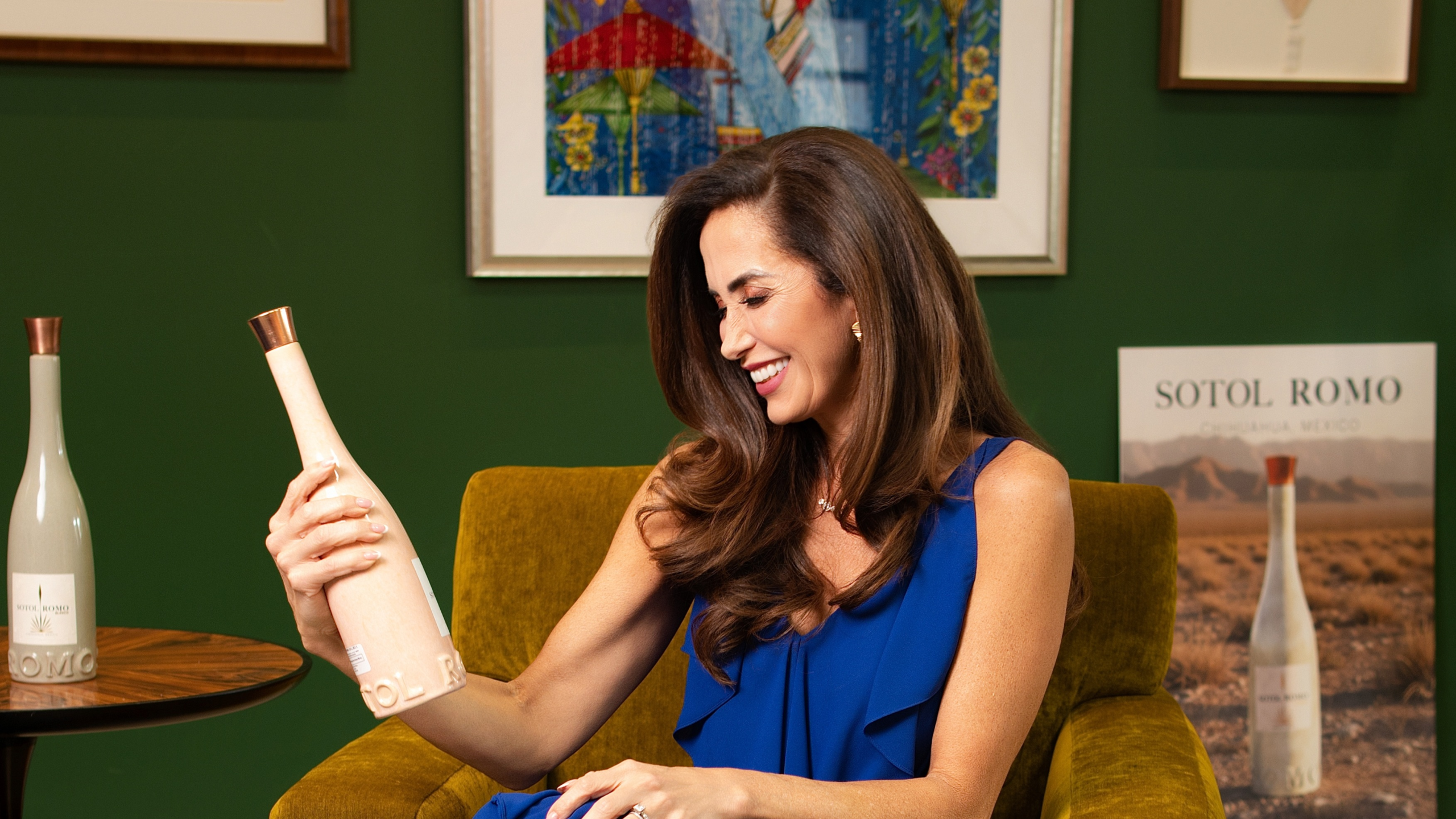
Within a young category, Sotol Romo is positioned at the top. The bottle, in copper tones drawn from the Sierra Madre and the Copper Canyon, is what she called “a love letter to the desert.” The liquid profile was shaped with Richard Betts, her co-founder, and the brand is a co-venture with Casa Komos Brands Group, per the company’s launch announcement.
The positioning is deliberate and, she says, political. “I do not want people to keep seeing Latinos as Cholula, but as Chanel,” she said, arguing that Latin American products are celebrated culturally far more often than they are valued economically at the luxury tier.
Building the Category, Not Only the Brand
Rather than compete with the other sotol producers, whose numbers she says have tripled in recent years, Romo Edelman has been assembling them into a collective that uses shared terminology to educate drinkers. The ambition is speed: tequila took about 30 years to go mainstream and mezcal about 15, she said, so the goal for sotol is five.
Her stated objectives for the next three years are narrow: build a brand, sell, and educate about sotol. Chasing transactions alone, she said, produces linear growth, while building a brand compounds.
Where to Find It, and What It Costs
Sotol Romo made its US debut during Super Bowl week in San Francisco in February 2026, and launched in New York and the Hamptons on July 1, 2026, ahead of the July 4 weekend. The opening accounts include Nobu Downtown, Nubeluz, Bazaar Meat at the Ritz-Carlton, the Waldorf Astoria, Please Don’t Tell, Morton’s The Steakhouse, Casa Carmen, Mission Ceviche, Oriana and Amasa in New York, and Pierre’s, Dopo Il Ponte, Feniks and T-Bar in the Hamptons.
The Blanco carries a suggested retail price of $79 and the Reposado $89, and both are sold through sotolromo.com. In the interview she described New York and the Hamptons as the proving ground before expanding, with Cabo San Lucas the one Mexican market on the early map.
The Bet on Northern Mexico
The commercial plan sits on top of a regional one. What tequila did for southern Mexico, creating jobs, industry and attention, Romo Edelman wants sotol to do for the north, where she says the desert grows little else. More demand, in her account, means more distilleries, more work, more schools and more reason for young people to stay.
She also described commitments attached to the brand: turning sotol fibre left over from production into bricks used to build schools in producing communities, and directing a share of profits to the Latino community in the United States, which staffs much of the hospitality industry the brand depends on. “If you talk a game and you do not do it, people feel it,” she said.
Quick Answers
What Is Sotol?
A distilled Mexican spirit made from the sotol plant, Dasylirion, which grows wild in the desert of northern Mexico. Chihuahua is its denomination of origin region.
Is Sotol the Same as Tequila or Mezcal?
No. Tequila and mezcal are made from agave. Sotol comes from a different plant, and Romo Edelman describes the result as lighter and less smoky than mezcal.
What Is Sotol Romo Made From?
100% Dasylirion cedrosanum, water and natural ambient fermentation, with no additives, per the brand.
Where Can You Buy Sotol Romo?
Online at sotolromo.com, and by the glass at the New York and Hamptons accounts listed above.
This article is based on Iconic Original Media’s interview with Claudia Romo Edelman, conducted in Spanish by Advin Illa. Quotes have been translated. Watch the full interview.